
-
Pest SolutionsPESTS + WEEDSUSING PESTICIDES OR HERBICIDES?

I should be a large image.
Brown Marmorated Stink Bug
Halyomorpha halys
Updated Apr 20, 2026
Make a Positive Identification
Brown marmorated stink bugs are marbled brown, shield-shaped bugs about 5/8 inches long. They may congregate in large numbers on the warm sides of buildings. They are a major crop and fruit pest, and damage many ornamental plants.
Species: Brown marmorated stink bug
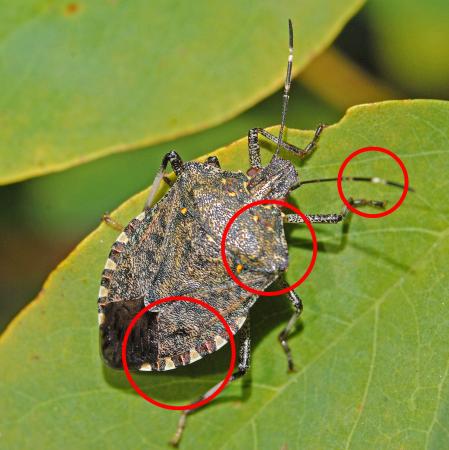
Steven Valley, Oregon Department of Agriculture, Bugwood.org
Adults are about 5/8 inch long, and marbled brown. Identifying features are:
- Distinct white bands on the dark antennae.
- Smooth margin on the front edge of the “shoulders”.
- White bands on sides of the wings.
- White bands on legs.
- They emit a strong cilantro-like smell when disturbed or crushed.
Species: Brown marmorated stink bug
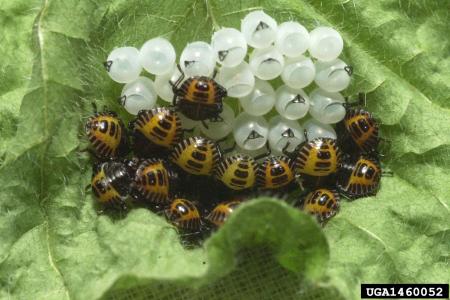
David R. Lance, USDA APHIS PPQ, Bugwood.org
Immature BMSB (nymphs) molt five times as they mature into adults. Each molting is called an “instar”. Instar #1 (newly hatched) is black with yellowish red markings on the abdomen.
Two generations per season can occur in Oregon.
Species: Brown marmorated stink bug
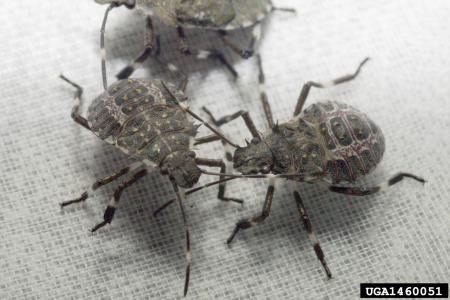
David R. Lance, USDA APHIS PPQ, Bugwood.org
Nymphs grow larger with each instar. Older instars have rectangular spots on the back of the abdomen.
All instars have a spiny margin on the front edge of the “shoulders”.
Species: Brown marmorated stink bug
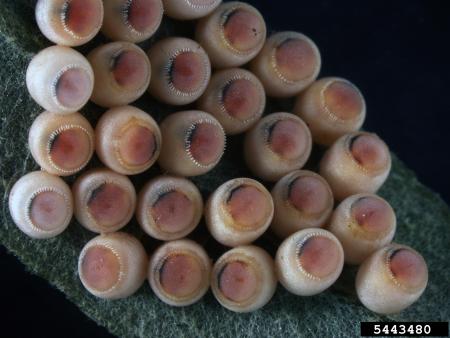
Susan Ellis, Bugwood.org
Eggs are laid in clusters ranging in number from 25-30 eggs. They are barrel shaped, and white to pale green. Short spines encircle the top. They are attached to the underside of leaves.
Species: BMS damage
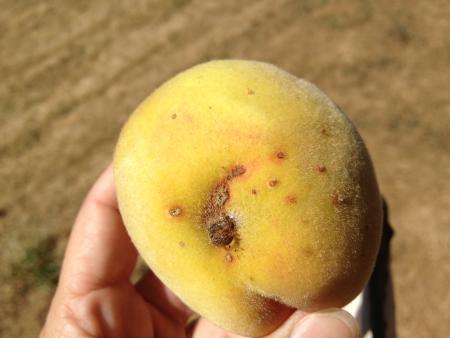
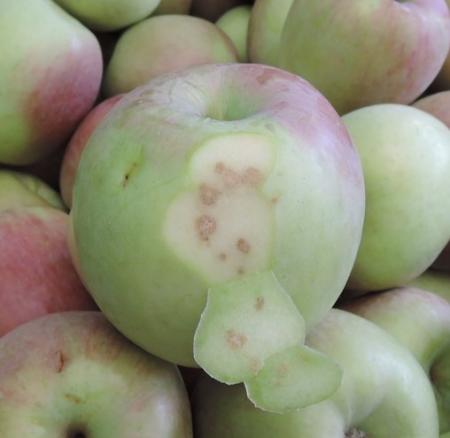
Sylvia Rondon, Oregon State University
Brown Marmorated Stink Bug damage
Adults and nymphs inject tissue-destroying enzymes and suck juices from fruit and seeds. They create pockmarks and distortions that make fruit and vegetables unmarketable. Damaged flesh under the skin turns hard and pithy.
LOOK-ALIKES: SIMILAR STINK BUGS
Species: Rough stink bug
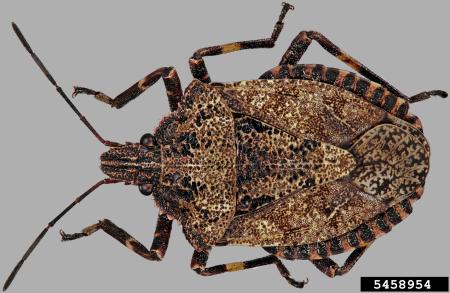
Steven Valley, Oregon Department of Agriculture, Bugwood.org
Rough stink bug, Brochymena sulcata, Differences from BMSB:
- No white bands on the antennae.
- Toothed (rough), rather than smooth, shoulder margin.
- Front of head has two points.
Species: Consperse stink bug
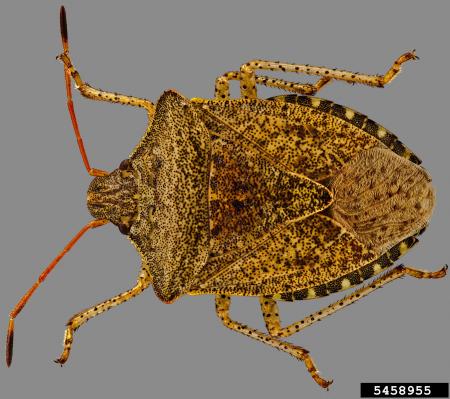
Steven Valley, Oregon Department of Agriculture, Bugwood.org
Consperse stink bug, Euschistus conspersus, Differences from BMSB:
- No white bands on the antennae.
- Finely toothed margin on front edge of shoulder.
- Legs have distinct dark spots rather than white bands.
- A little smaller, about 1/2 inch long.
Species: Shield bug
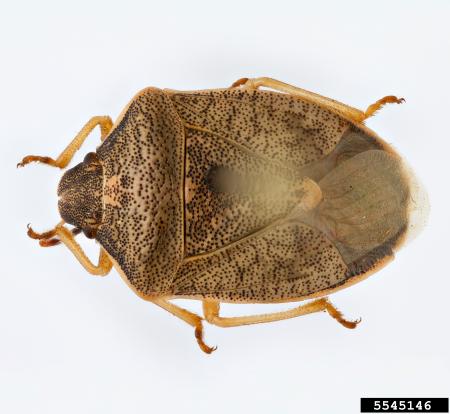
Hanna Royals, Museum Collections: Heteroptera, USDA APHIS PPQ, Bugwood.org
Shield bug, Holcostethus sp, Differences from BMSB:
- No white bands on the antennae.
- No white bands on legs.
- No white bands along edge of abdomen.
Brown Marmorated Stink Bug Benefits
- Brown marmorated stink bugs are food for other species of insects, spiders, and some birds and mammals.
Brown Marmorated Stink Bug Risks
- Brown marmorated stink bugs are a serious pest of many fruit and fruiting vegetable crops.
- They migrate into dwellings in the winter.
- Their excrement may leave spots on curtains, furnishings, and clothing.
- When crushed, they give off an offensive odor.
Risk Card
Does it cause harm?
Adults & Children
None
Property
Low
Pets
None
Annoyance
Some
Environment
None
Action Depends on Context
Action recommended for homes and buildings
NEED HELP?
Consider a licensed pest control company. Learn How to Hire a Pest Control Company.
Your local Extension Specialist in Oregon and other states can suggest other methods.
Content provided by editor Chris Hedstrom and writer Signe Danler. Pesticide safety information edited by Kaci Buhl.


BROWN MARMORATED STINK BUG REFERENCES
EMERGING PEST: Brown Marmorated Stink Bug—A Pending Threat to Pacific Northwest Agriculture
PNW Pest Management Handbooks
Samurai wasp: Promising egg parasitoid for management of Brown Marmorated Stink Bug (BMSB)
Oregon State University Extension publication em9164
Brown Marmorated Stink Bug
Oregon State University College of Agricultural Sciences, Department of Horticulture
Pest Watch: Brown Marmorated Stink Bug (Home Garden Series)
WSU Extension
Brown Marmorated Stink Bug
WSU Tree Fruit
Stink Bugs
National Pesticide Information Center
How to Manage Pests Pests in Gardens and Landscapes: Brown Marmorated Stink Bug
UC IPM