
-
Pest SolutionsPESTS + WEEDSUSING PESTICIDES OR HERBICIDES?

I should be a large image.
Japanese Beetle
Popillia japonica
Updated Jun 18, 2026
Make a Positive Identification
Japanese beetle is an invasive insect that feeds on more than 300 plant species. They eat field crops, berries, fruit trees, vegetables and many ornamental plants. The grubs (the immature stage) prefer to feed on grass roots.
Identify Japanese Beetle
Species: Japanese beetle
David Cappaert, Bugwood.org
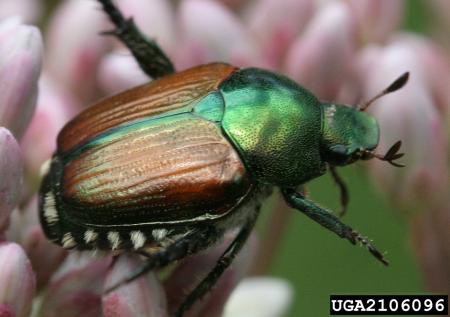
Japanese beetle adults are oval and a little less than a half-inch long. They have a green metallic head and bronze-brown wing covers.
Species: Japanese beetle
"20220715 Popillia japonica (Japanese Beetle)" by schizoform is licensed under CC BY 2.0
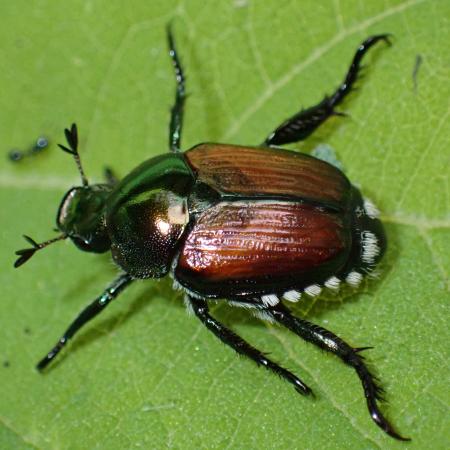
Adult beetles have white tufts of hair located along each side of the abdomen and rear.
Species: Japanese beetle
"Beetle Lollipop -- Japanese Beetles Attack Rose Flower" by scostello22 is licensed under CC BY 2.0
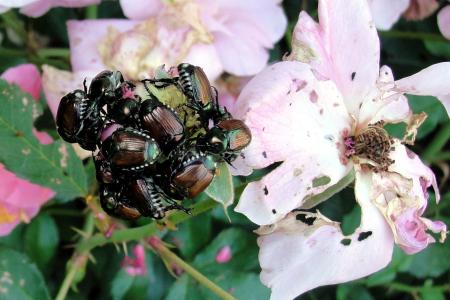
Japanese beetle adults feed on flowers and leaves of hundreds of plant species. They are often found in large groups feeding on plants.
Species: Japanese beetle
David Cappaert, Bugwood.org
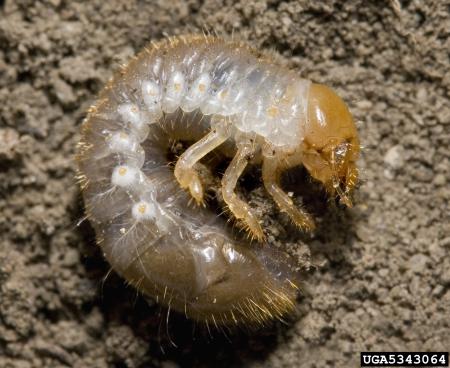
Japanese beetle grubs are curved, creamy white with dark ends. They look like many other insect grubs found in soil.
Species: Japanese beetle
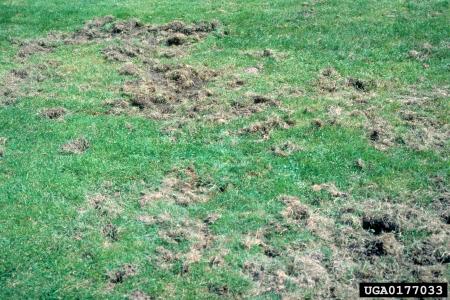
M.G. Klein, USDA Agricultural Research Service, Bugwood.org
Grubs feed on turf grass, and many landscape and garden plants. They damage large areas of turf grass. Japanese beetle is the most widespread turf grass pest in the United States.
Japanese Beetle Lookalikes: Golden Buprestid, Ground beetles, Klamathweed Beetle, Little Bear beetle
Species: Golden buprestid
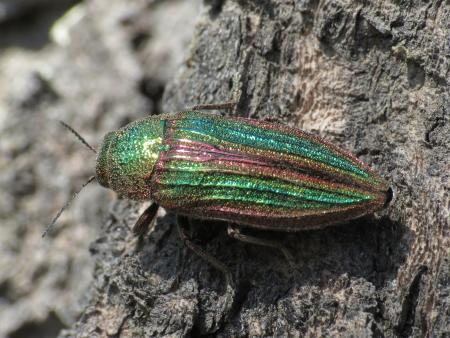
"Golden Buprestid" by treegrow is licensed under CC BY 2.0
Golden buprestid (Buprestis aurulenta) is a native wood-boring beetle. It has metallic green on its wing covers and head. The edges and center strip of the wing covers are reddish. It has a more elongate body than Japanese beetle. It is about 2/3 inch long; a little longer than Japanese beetle.
Species: Ground beetle
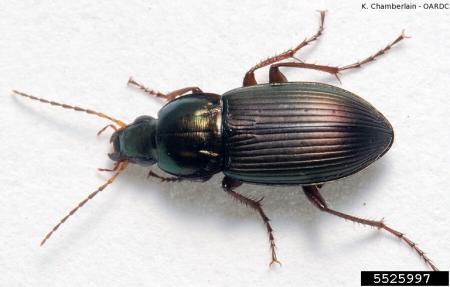
Ken Chamberlain, The Ohio State University, Bugwood.org
Ground beetles are generally larger than Japanese beetles, and usually lack metallic green coloring. They don't have hairy tufts at the edges of their wing covers.
Species: Klamath weed beetle
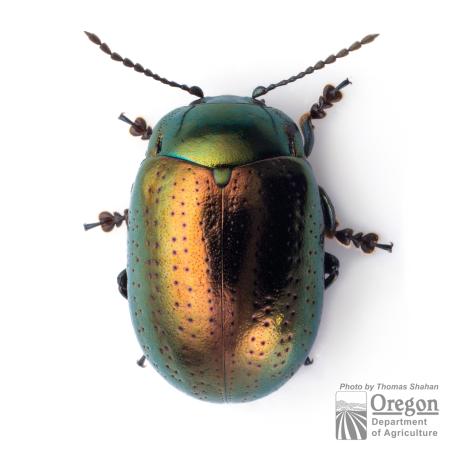
"Chrysolina quadrigemina - Klamath Weed Beetle" by Oregon Department of Agriculture is licensed under CC BY-NC-ND 2.0
Adult Klamathweed beetles (Chrysolina quadrigemina) are about 1/4 inch in diameter. Their color ranges from metallic green to almost greenish black. They were imported from Europe for control of the noxious weed St. John’s Wort (Hypericum performatum).
Species: Little bear beetle
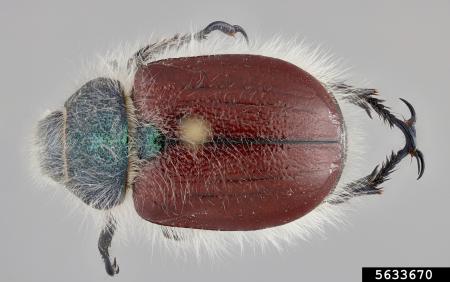
"Paul Langlois, Museum Collections: Coleoptera, USDA APHIS PPQ, Bugwood.org
The little bear beetle (Paracotalpa granicollis) has similar coloring to Japanese beetles. It is very hairy, especially around the edges of its shell. It is about 1/2 to 3/4 inches (12-18mm) long. It is found in eastern and southern Oregon.
Japanese Beetle Benefits
Japanese beetles are regarded as pests. They don’t have any benefit for people or the environment.
Japanese Beetle Risks
- Japanese beetle adults feed on hundreds of types of plants. They are a threat to agricultural crops, gardens, public parks, and urban forests.
- The grubs damage lawns by eating the roots. Japanese beetle is considered the worst turfgrass pest in eastern and Midwestern states where it is established.
- Populations can increase and spread very fast.
Risk Card
Does it cause harm?
Adults & Children
None
Property
High
Damage lawns and 100s of plants
Pets
None
Annoyance
High
Very difficult to control
Environment
High
Pose a threat to the region
Action Highly Recommended
TAKE ACTION
Watch for Japanese beetles on your property and in public landscapes. The best way to keep them from getting established in Oregon is to spot and destroy them early.
What damage do Japanese beetles cause?
- Japanese beetles damage grass, field crops, orchards, and nursery, landscape, and garden plants.
- Adults damage leaves, and consume flowers and fruits.
- Japanese beetle grubs feed on plant roots. They damage turf areas such as lawns, parks, golf courses, and pastures. They are the most widespread turf grass pest in the United States.
Do I need to take action?
- Yes. Japanese beetles pose a major threat to the Pacific Northwest. They cause significant damage to lawns, trees, and shrubs. In the United States, the cost of losses and control efforts is over $460,000,000 a year.
- If you think you’ve found Japanese beetles in Oregon, please report them to the Oregon Invasive Species Hotline at: 1-866-INVADER (1-888-468-2337) or use their online reporting form
PREVENTING JAPANESE BEETLE
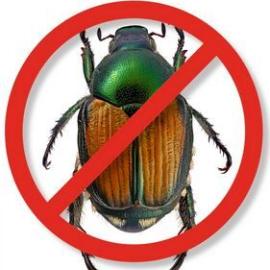
ODA
Be alert and report Japanese beetle if you see it
If you think you’ve found Japanese beetles in Oregon, report them to the Oregon Invasive Species Hotline at 1-866-INVADER (1-888-468-2337) or use their online reporting form
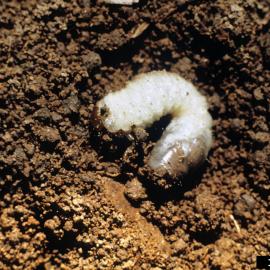
Jim Baker, North Carolina State University, Bugwood.org
Don't move plants with soil that may contain Japanese beetle grubs
- Don't transport plants or soil from infested Eastern states. They could contain Japanese beetle larvae.
- Oregonians near and in infested areas should not move plants outside of the infested area. Do not engage in plant swaps or sales that move plants outside a known infested area.
- If you are within a Japanese beetle quarantine area in Washington County, take yard debris to a disposal site from this list: Yard Debris Waste Disposal Sites in Washington County
- If you are outside the infested area, be cautious when sharing plants. Check for grubs in the soil if you trade or share plants.
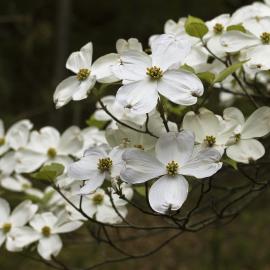
"dogwood flowers" by Muffet is licensed under CC BY 2.0
Choose plants that are less attractive to Japanese beetles. Avoid or replace plants preferred by them.
- Plants resistant to Japanese beetle feeding include dogwoods, pines and lupines.
- They especially prefer feeding on Japanese maples, grapes, roses and hibiscus.
SOLUTIONS FOR JAPANESE BEETLE
Early Detection & Rapid Response
- Keen eyes and quick reporting could be vital for keeping this pest from getting established in Oregon.
- If you suspect you have found the adult beetle or the C-shaped larvae, report it to the Invasive Species Hotline, 1-866-INVADER (1-888-468-2337) or use their online reporting form.
Hand Picking
- Hand picking can be effective with very small infestations. Report ANY sightings.
Monitoring and Trapping
- The ODA uses pheromone traps to trap and monitor Japanese beetle presence in Oregon. They are not recommended for home use at this time.
Reduce Irrigation (if Japanese beetles have been found in your area)
- Reduce or stop irrigating lawns when females are laying eggs and larvae are growing. That will help lower their survival rate.
- Allowing lawns to go dormant during the summer months can also help.
Insecticides
- The ODA will arrange for the application of insecticides if Japanese beetles are confirmed in your area. This will ensure proper treatment and eradication of this pest.
- If you are in a Japanese beetle treatment area, you will be contacted by the ODA. They will inform residents when treatment is needed.
- In Oregon the use of insecticides for Japanese beetles is not currently recommended for home use.
NEED HELP?
Consider a licensed pest control company. Learn How to Hire a Pest Control Company.
Your local Extension Specialist in Oregon and other states can suggest other methods.
Jump to
| Method | Does it work? | Is it safe? | Recommendation |
|---|---|---|---|
A Early Detection & Rapid Response |
Very effective |
Low risk |
Recommended |
B Hand picking |
Somewhat effective |
Low risk |
Recommended |
C Monitoring and Trapping |
Somewhat effective |
Low risk |
Not Recommended |
A
Early Detection & Rapid Response
Non-Chemical Method

Early Detection & Rapid Response
Recommended
| Does it work? | Very effective Keen eyes and quick reporting could be vital for keeping this pest from getting established in Oregon. |
| How much effort? | Low effort If you suspect you have found the adult beetle or the C-shaped larvae, report it to the Invasive Species Hotline |
| What's the risk? | Low risk |
| Possible risk of exposure or harm from chemicals | NONE |
B
Hand picking
Non-Chemical Method
Whitney Cranshaw, Colorado State University, Bugwood.org
Hand picking
Recommended
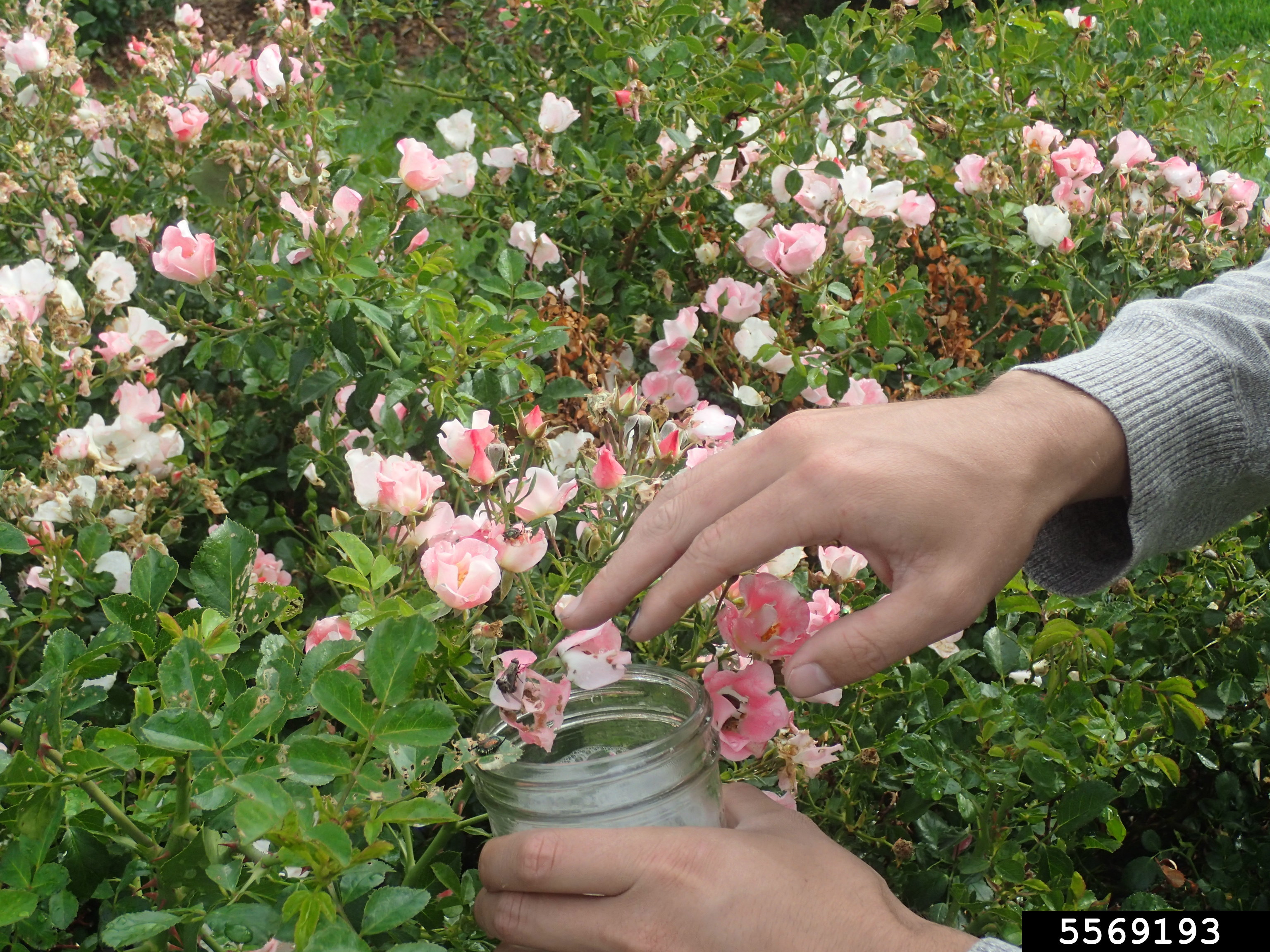
Hand-picking Japanese beetles can be effective with small infestations. Shake infested plant parts over a collecting container in early morning when it is cool. Remove and kill the beetles.
| Does it work? | Somewhat effective |
| How much effort? | Moderate effort |
| What's the risk? | Low risk |
| Possible risk of exposure or harm from chemicals | NONE |
C
Monitoring and Trapping
Non-Chemical Method
iStock
Monitoring and Trapping
Not Recommended
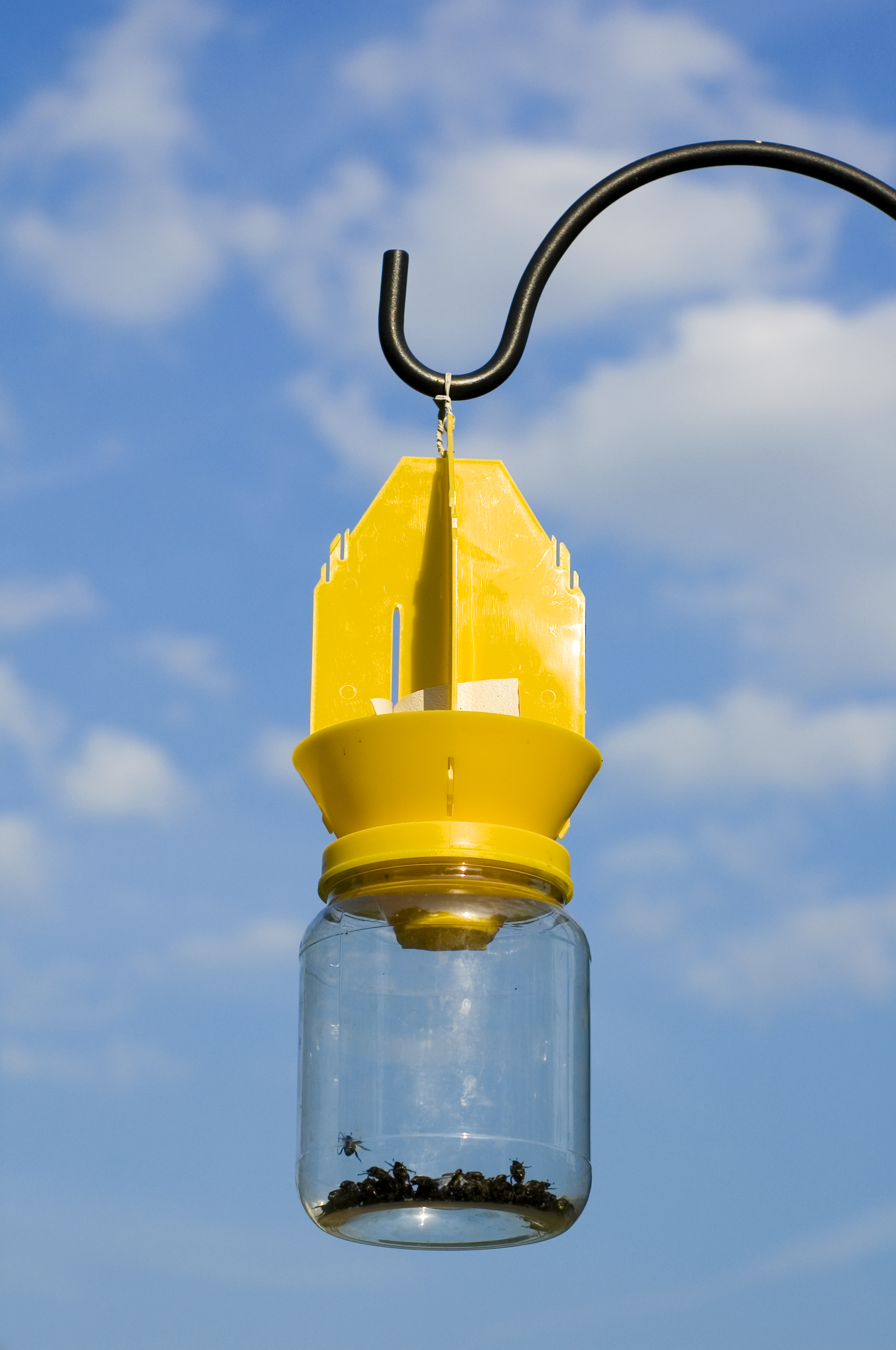
- Japanese beetle traps are not recommended for homeowner use. They are best used by commercial and government bodies for monitoring purposes.
- Pheromone traps attract and monitor adult beetles. They are useful for detecting the presence of Japanese beetle for survey purposes.
- The traps do not reduce the number of beetles damaging nearby vegetation. In fact, they can increase damage by attracting large numbers of beetles.
| Does it work? | Somewhat effective |
| How much effort? | Low effort |
| What's the risk? | Low risk |
| Possible risk of exposure or harm from chemicals | NONE |
Invasive Species Alert
- Invasives are non-native species that spread aggressively and alter the environment.
- Learn about Japanese beetles in Oregon.
- If you think you’ve found Japanese beetles in Oregon, please report them to the Oregon Invasive Species Hotline at: 1-866-INVADER (1-888-468-2337) or use their online reporting form

Invasive species data @ 2022, iMapInvasives (NatureServe)
View Larger Map >
If you find signs of Japanese beetles anywhere in Oregon, please report it.
Content provided by Signe Danler and Weston Miller. Pesticide safety information edited by Kaci Buhl.
Peer review facilitated by OSU Department of Horticulture.



Japanese Beetle References
Japanese Beetles in Oregon
OSU Extension Service Publication
Japanese Beetle
Oregon Dept. of Agriculture (ODA) fact sheet
Japanese Beetle
PNW Pest Management Handbooks
Japanese Beetle PDX website
Oregon Dept. of Agriculture (ODA)
Japanese Beetle
USDA – APHIS pamphlet