
-
Pest SolutionsPESTS + WEEDSUSING PESTICIDES OR HERBICIDES?

I should be a large image.
Squash Bug
Anasa tristis
Updated Apr 20, 2026
Make a Positive Identification
- Squash bugs are flat, grayish-brown flying bugs.
- They suck the sap from squash and pumpkin plants, as well as other cucurbits. This causes wilting and in some cases plant death.
- Squash bugs may spread plant viruses. They damage tissue with their piercing-sucking mouthparts. If major damage is noticed, it might be worth having your plant tested for viruses. OSU Plant Clinic
- In Oregon there is one generation per year. Adults overwinter and lay eggs about the time the squash vines begin to spread. They hatch into nymphs after about 10 days. Nymphs develop into adults in 4 to 6 weeks.
Species: Squash bug
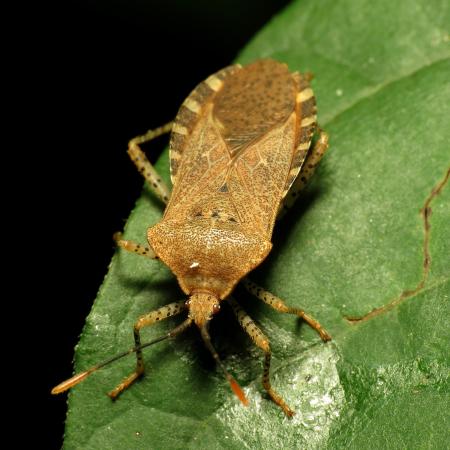
"Squash Bug (31373558580)" by Katja Schulz from Washington, D. C., USA is licensed under CC BY 2.0
Adult squash bugs are 5/8 inch (1.5cm) long and 1/3 as wide. They are grayish brown with a flat back. The edge of the abdomen usually has pale orange stripes or spots.
Species: Squash bug
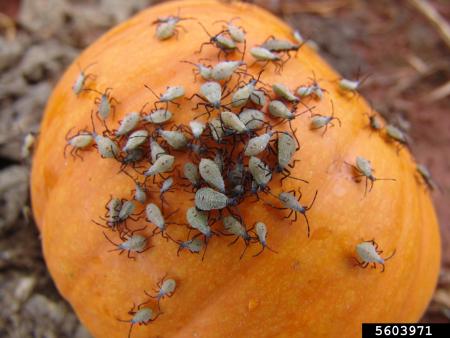
Gerald Holmes, Strawberry Center, Cal Poly San Luis Obispo, Bugwood.org
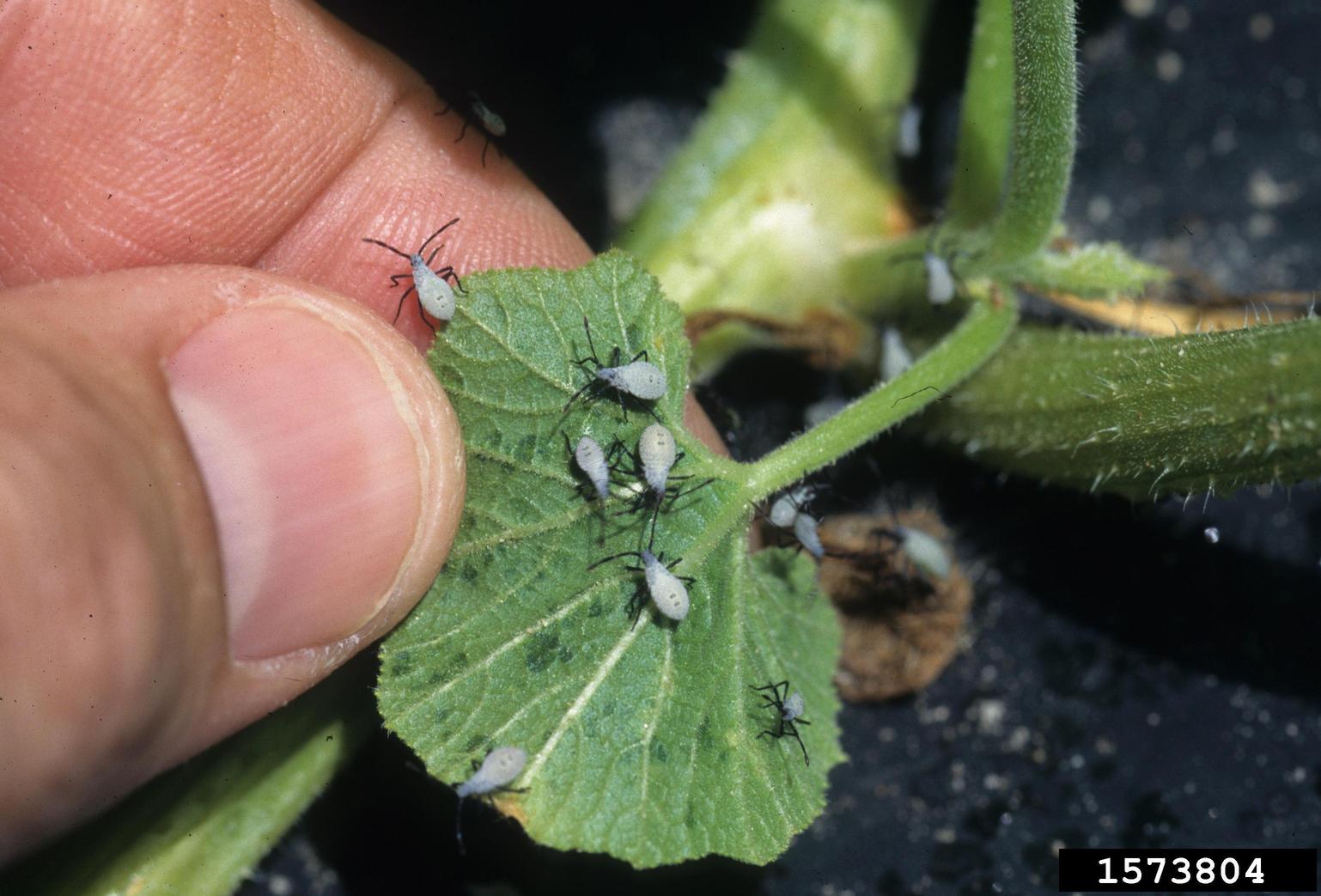
Squash bug nymphs hatch in spring. They are grayish with a crimson head, thorax, and antennae. They may be covered with whitish powder, and are wingless. Nymph size varies between 3/16 to 1/2 of an inch. They molt several times into larger nymphs (instars). Older nymphs are grayish white with black legs and antennae.
Species:
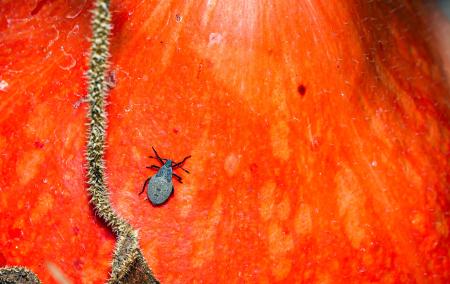
Alice Formiga, Oregon State University
Gray squash bug nymph with black legs.
Species: Squash bug
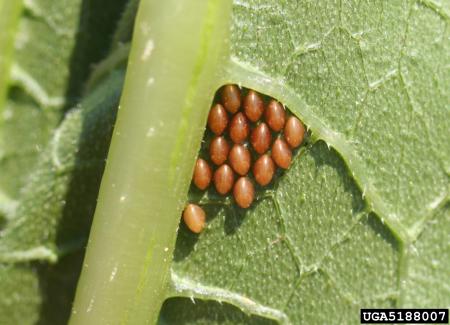
Whitney Cranshaw, Colorado State University, Bugwood.org
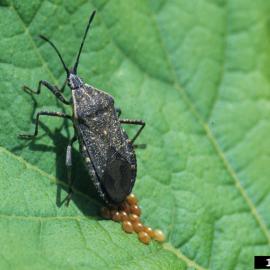
Squash bug eggs are 1/16 of an inch long. They are copper colored and laid in groups on the undersides of leaves.
Species:
Gerald Holmes, Strawberry Center, Cal Poly San Luis Obispo, Bugwood.org
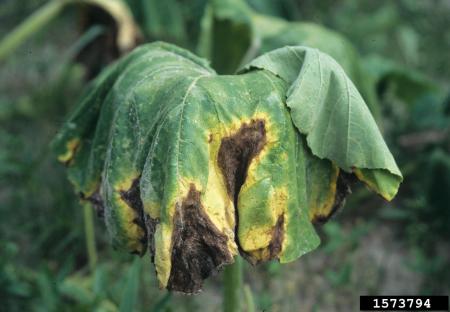
Squash bugs feed exclusively on squash, pumpkin, melon, and other plants in the cucurbit family. Adults and nymphs suck plant juices. Leaves become speckled, then yellow or brown. If leaf tissue looks like the photo, the plant may be affected by a virus that can be spread by squash bugs. Also, the plants may wilt under heavy feeding and can die.
Species:
Whitney Cranshaw, Colorado State University, Bugwood.org
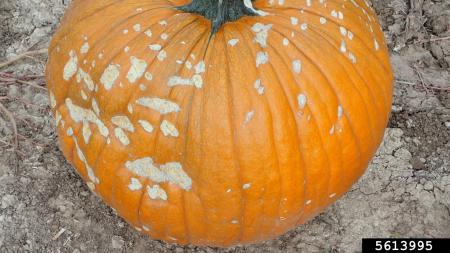
Squash bugs also feed on and scar developing fruits.
Lookalikes: Stinkbugs
Species: Stink bug
"Euschistus variolarius" by Theo Rickert is licensed under CC BY 4.0
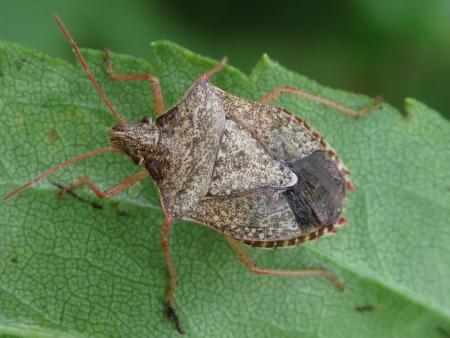
Squash bugs may be mistaken for some kinds of stink bugs. They have a similar shield shape, and both have an unpleasant odor when crushed.
Stink bugs are wider and rounder than squash bugs. They emit a noxious odor if disturbed.
The nymphs of Oregon stink bug species are all or partly black, not gray.
Squash Bug Benefits
Squash bugs are a food source for some insects and birds. Not many creatures eat them because of the bad odor the bugs release when they are disturbed.
Squash Bug Risks
- Squash bugs damage cucurbit plants and fruits. Severe damage can cause plant death.
- Feeding on fruits can cause scars and sunken areas that reduce usability and increase fruit rot during storage.
Risk Card
Does it cause harm?
Adults & Children
None
Property
Some
Pets
None
Annoyance
Some
Environment
None
Action Optional
Take Action?
Squash bugs reproduce quickly. If damage is ignored, the population may get out of hand.
Do I need to take action?
- You can ignore minor damage. It may get worse each year.
- If squash bugs damage your cucurbit crops too much, you may need to take preventive measures.
What if I do nothing?
High populations can cause serious damage and loss of harvest. In some parts of the United States, squash bugs can transmit a plant virus, Cucurbit Yellow Vine Decline (CYVD). It is not yet widespread in the PNW, but could be a risk. It can cause young plants to suddenly wilt and collapse.
Prevent Squash Bugs
Signe Danler, Oregon State University
Sanitation
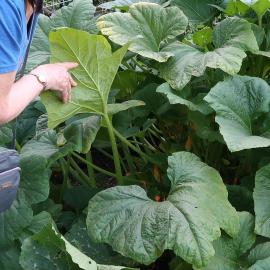
- The best method for squash bug control is prevention through sanitation.
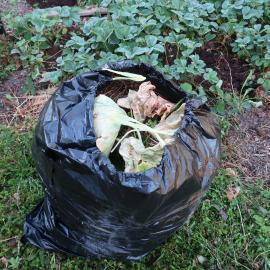
- Remove and destroy all dead plants soon after harvest. They can be bagged, burned, composted or tilled under.
- Remove plant debris from around plants. This will reduce overwintering sites for adult squash bugs.
Signe Danler, Oregon State University
Monitoring
- Inspect plants frequently for squash bug adults, nymphs, and eggs, especially early in the season.
- Watch for and destroy adults before they mate and lay eggs. Watch for and destroy egg masses. You can squish them against the leaf, or capture them with sticky tape rolled around your fingers. You can also smother them with oil or petroleum jelly.
- Adults and nymphs are stealthy. They will actively move away and hide from an approaching human.
- Check tops and bottoms of leaves and around the base of the plant. If there is plastic mulch or landscape fabric, check around the edges. This is a good squash bug hiding place.
- Watch for plants that look wilted. They often have squash bugs.

"D75_7411-1" by Mark F. Levisay is licensed under CC BY 2.0
Row covers to exclude squash bugs
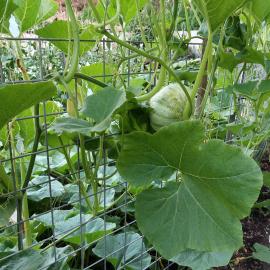
- Row covers can be used to protect plants early in the season. Install at planting time.
- Seal the bottom edges with dirt or rocks to keep squash bugs from entering.
- Monitor to make sure they have not gotten in while the plants are growing.
- Remove row covers at bloom time to allow for pollination.
Signe Danler, Oregon State University
Trellising
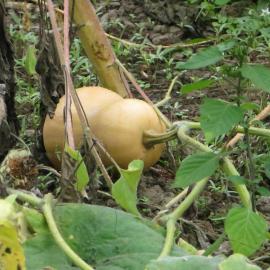
- Squash bugs like to hide near the base of vines.
- Use a trellis to raise vining types of squash and melons. This can make them less accessible to squash bugs.
Signe Danler, Oregon State University
Plant selection
- Squash bugs are most attracted to pumpkins and squash. They are less attracted to cantaloupe, cucumbers, and watermelons. When squash bug populations are high, though, they will eat all cucurbits.
- Butternut and Royal Acorn squash are more resistant to squash bugs. Green Striped Cushaw and Sweet Cheese varieties are moderately resistant.
Gerald Holmes, Strawberry Center, Cal Poly San Luis Obispo, Bugwood.org
Trap crops
- Squash bugs are especially attracted to yellow straightneck and crookneck squashes.
- Plant these several weeks before the main crop. They will attract overwintering adult squash bugs to lay their eggs.
- Destroy the plants, bugs and all, before eggs hatch. This will reduce squash bug populations.

Signe Danler, Oregon State University
Crop rotation
- Rotate planting areas to non-cucurbit crops in alternating years.
- This will minimize the population of overwintering adult squash bugs.
- Rotation is most effective in larger fields.
Solutions for Squash Bugs
Non-chemical Methods
- Inspect plants regularly for egg masses, adults and nymphs.
- Handpick and destroy squash bug adults, nymphs and eggs.
- Encourage natural enemies that prey on squash bugs (see Biological Controls below). Grow insectary plants like alyssum that provide them with food.
Insecticides (Insect Killers)
- Squash bugs are hard to kill using insecticides. Egg masses, nymphs, and bugs are hidden and hard to reach with sprays.
- Avoid using pesticides. They will also kill natural enemies.
NEED HELP?
Consider a licensed pest control company. Learn How to Hire a Pest Control Company.
Your local Extension Specialist in Oregon and other states can suggest other methods.
Jump to
| Method | Does it work? | Is it safe? | Recommendation |
|---|---|---|---|
A Handpicking |
Effective |
Low risk |
Recommended |
B Biological Control |
Somewhat effective |
Low risk |
|
C Control with Insecticides |
Somewhat effective |
Moderate risk |
Not Recommended |
|
D If Using Insecticides, Protect Yourself & Minimize Risks
|
A
Handpicking
Non-Chemical Method
Gerald Holmes, Strawberry Center, Cal Poly San Luis Obispo, Bugwood.org
Handpicking
Recommended
Place boards, shingles or heavy cardboard on the ground near crops. Squash bugs and nymphs will hide under them at night.
In the morning, collect and destroy the bugs. Knock them into a bucket of soapy water to drown, or bag them and freeze them.
You can also walk on the boards to kill the bugs below.
Destroy any egg masses you find.
| Does it work? | Effective |
| How much effort? | High effort |
| What's the risk? | Low risk |
| Possible risk of exposure or harm from chemicals | NONE |
B
Biological Control
Non-Chemical Method
Russ Ottens, University of Georgia, Bugwood.org
Biological Control
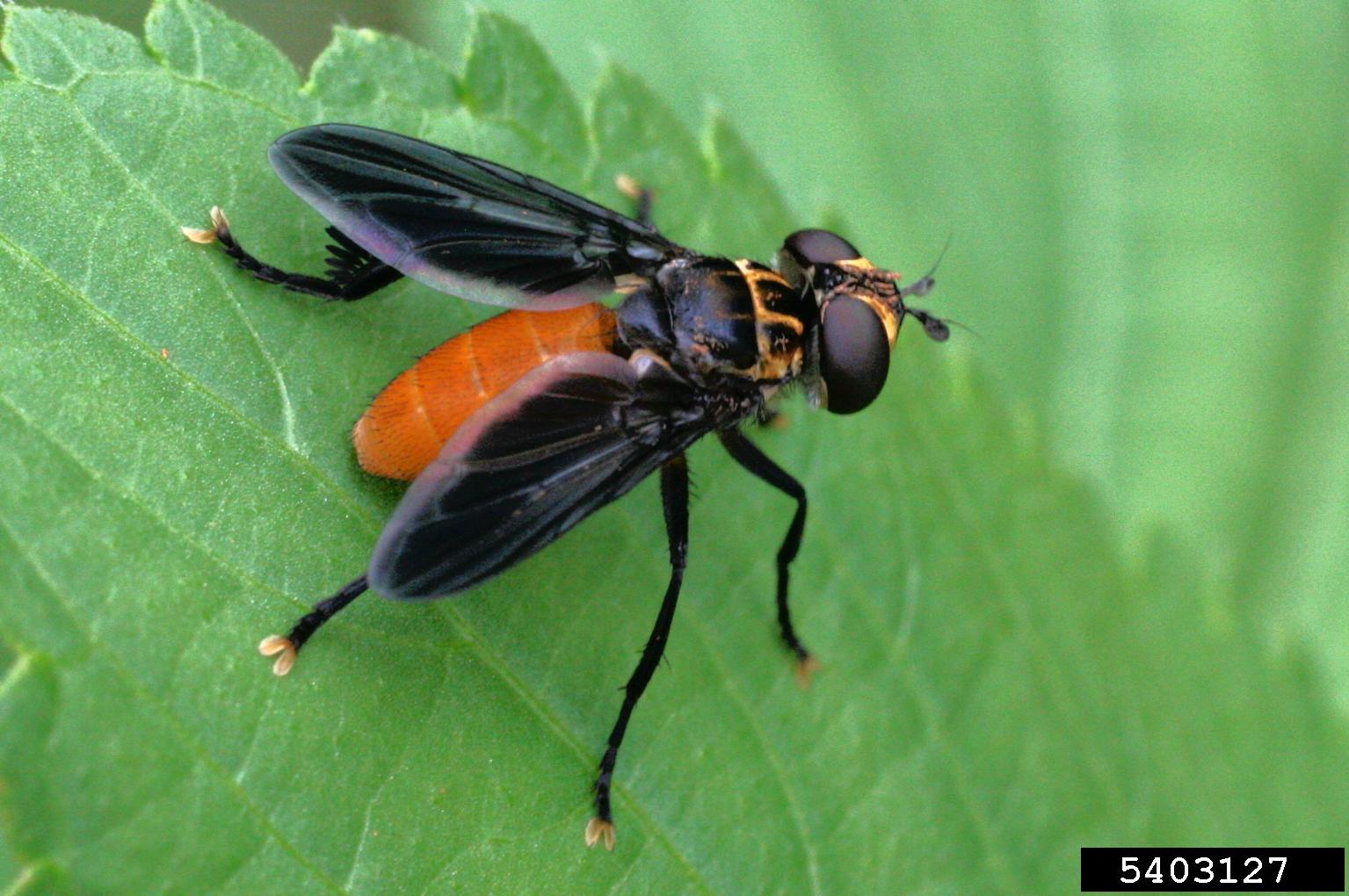
A tiny parasitic wasp (Gryon pennsylvanicum) and a tachinid fly (Trichopoda pennipes) are natural enemies of squash bugs. They lay eggs on the squash bugs. The larvae mature in the squash bug and kill it.
A few spiders, ground beetles, robber flies, and lady beetles eat squash bugs. Few predators eat squash bugs because of the noxious odor they release.
Encourage natural enemies by planting insectary flowers and avoiding pesticides. A diverse landscape supports predators and parasitoids.
| Does it work? | Somewhat effective Natural enemies will not eliminate squash bugs. They can reduce populations. |
| How much effort? | Moderate effort |
| What's the risk? | Low risk |
| Possible risk of exposure or harm from chemicals | NONE |
C
Control with Insecticides
Chemical Method: Use with caution

iStock
Control with Insecticides
Not Recommended
- Squash bugs are hard to kill using insecticides. Egg masses, nymphs, and adults stay hidden and are hard to reach with sprays.
- Squash bugs often develop resistance to insecticides.
| Does it work? | Somewhat effective
|
| How much effort? | Moderate effort |
| What's the risk? | Moderate risk |
| Possible risk of exposure or harm from chemicals | Using insecticides includes some amount of risk. The lowest risk comes with using alternative methods.
You may be exposed to an insecticide if you:
Follow label directions to reduce risk. |
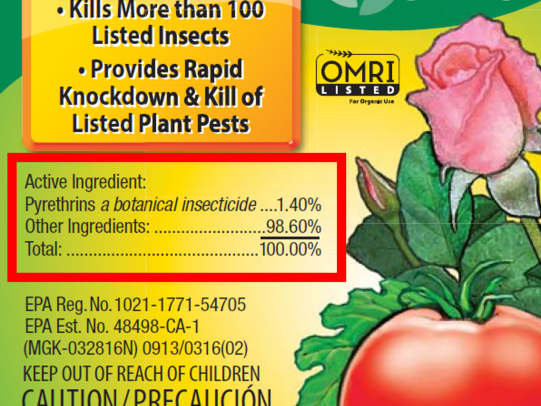
Some insecticides are available for home use. A few are listed below. These active ingredients are suggested chemical treatments to control squash bugs. Look for these chemical names in the “Active Ingredients” section of product labels.
- Neem extract (Azadirachtin) Some formulations are OMRI-listed for organic use.
- Acetamiprid
- Carbaryl
- Pyrethrin
Suggested active ingredients are from the Pesticide Information Center Online (PICOL) Database. They are permitted for HOME use in Oregon. Read the label for application directions and effectiveness information.
ONLY professional pesticide applicators can use Restricted-Use Pesticides (RUP) that may be more effective. If you need further support, contact a licensed pesticide applicator.
Insecticide Application Tips
- The best method of control can be handpicking combined with least-toxic insecticides.
- Apply insecticides early in the season, before flowering and vining begin.
- Apply early or late in the day when temperatures are cooler. Apply when fruits are dry. Pesticides may injure cucurbit fruits if applied when they are wet.
- The spray must contact nymphs to kill them. They may be hidden deep within the plants.
- More toxic insecticides also kill bees and beneficial insects such as predators and parasites. These insects help to keep other pest insects in check.
If Using Insecticides, Protect Yourself & Minimize Risks
Chemical Method: Use with Caution
"Sierran Tree Frog (Pacific Chorus Frog) - Pseudacris sierra" by az3 is licensed under CC BY-NC-SA 2.0 (cropped).
Why Is It important to Read Insecticide Labels?
- They have detailed information on how to use the product correctly and legally.
- They contain information on potential hazards of the product.
- They provide instructions you should follow for poisonings and spills.
- Following label instructions helps you to minimize the risks and maximize the benefits.
Key Safety Tips
- Read the entire label front to back.
- Follow the instructions.
- Review the instructions even for brands you know.
- Only apply the product where the label says it may be applied.
- Keep all insecticides in their original container.
The Label is the Law
ALWAYS read the label before using insecticide products. The label is a legal document that provides information on how to safely use the insecticide. It includes required personal protective gear and application methods. This helps avoid harm to human health and the environment. Using an insecticide in ways not listed on the label is illegal. It can result in legal enforcement actions.
READ THE LABEL & Follow Instructions
It has instructions to protect you and the environment.
- Labels are different for every product and they often change over time.
- Use a magnifying glass for small print.
- Pay attention to CAUTION, WARNING, and DANGER statements.
- Pay attention to the PRECAUTIONARY STATEMENTS.
- The law states you must read and follow insecticide instructions.
Protect Yourself
Eye, skin, & lung irritants
- Wear the right protective gear. This often includes, but is not limited to: a long-sleeved shirt, pants, socks, closed shoes, safety glasses, and chemical-resistant gloves.
- Avoid contact with eyes, skin, or clothing.
- Wash hands after mixing or applying, and before eating or smoking.
- Never spray directly overhead. Pay attention to wind conditions.
Protect Children & Pets
Keep out of the reach of children.
- Keep children and pets away from the application area (read label for how long).
- Remove toys and pet dishes from the area before applying insecticides. Wait until spray has dried or dust has settled.
Protect Pollinators
Many insecticides are extremely toxic to bees.
- Honey bees and other pollinators are harmed by most insecticides.
- Don’t spray on bees or other flying insects.
- Don’t allow spray to contact blooming plants.
Avoid Wet Weather & Keep Insecticides Out of Waterways
Some insecticides are toxic to fish and aquatic invertebrates.
- Don’t spray insecticides in water.
- Insecticides sprayed on plants can wash off with rain and enter waterways.
Storage & Disposal
- Store out of the reach of children and pets.
- Store in a cool and dry place.
- Never pour down any drain.
- If you mix too much, apply it according to the label rather than storing it.
- Don’t put pesticide containers in the trash unless instructed by the label.
- Take unused insecticides to a hazardous waste facility.
Call 1-800-CLEANUP (1-800-253-2687) to find out where to dispose of pesticides.
For the Portland metro region in Oregon, contact Metro’s Recycling Information. Call 503-234-3000, email or visit Metro’s website
More about:
About Using Pesticides on School Grounds in Oregon
If using pesticides on school grounds, there are special rules in Oregon. See School Integrated Pest Management (Oregon Department of Agriculture).
NEED HELP?
The National Pesticide Information Center (NPIC) can answer questions about pest control chemicals.
1-800-858-7378 or npic@ace.orst.edu
Consider using a licensed pest or weed control company. Learn How to Hire a Pest Control Company.
Your local Extension Specialist in Oregon and other states can suggest other methods.
Content developed by Signe Danler and reviewed by Thomas A. Jima. Pesticide safety information edited by Kaci Buhl.
Peer review facilitated by OSU Department of Horticulture.



Vegetable crop pests-Squash bug
PNW Pest Management Handbooks
Pests in Gardens and Landscapes: Squash Bugs
Univ. of California IPM program
Squash Bug
Utah State University
Squash Bug Integrated Pest Management (.pdf)
Utah State University Extension
Integrated Pest Management (IPM) for Squash Bug for Home Gardens and Small-scale Growers
New Mexico State University
Squash Bug and Squash Vine Borer: Organic Controls
ATTRA Sustainable Agriculture
H. B. Doughty, J. M. Wilson, P. B. Schultz, T. P. Kuhar, Squash Bug (Hemiptera: Coreidae): Biology and Management in Cucurbitaceous Crops, Journal of Integrated Pest Management, Volume 7, Issue 1, January 2016, 1, https://doi.org/10.1093/jipm/pmv024
Stink Bugs of Oregon (.pdf)
Oregon Dept. of Agriculture