
-
Pest SolutionsPESTS + WEEDSUSING PESTICIDES OR HERBICIDES?

I should be a large image.
Peach Leaf Curl
Taphrina deformans
Updated Apr 30, 2026
Make a Positive Identification
- Peach leaf curl is a fungus that causes peach and nectarine leaves to turn reddish and become thickened, curled, and puckered.
- It can also affect stems and fruit, causing stunting and distortion.
- This disease is a major problem of peaches in western Oregon. It can also be a problem east of the Cascades.
- Peach leaf curl mostly develops during cool and wet growing seasons. In the Pacific Northwest, symptoms appear on the new leaves starting in spring. It gets worse over the season.
Species: Peach Leaf Curl
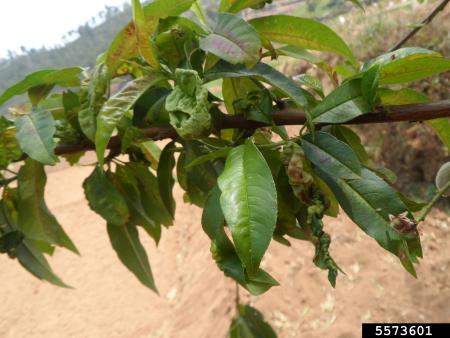
Dr Parthasarathy Seethapathy, Tamil Nadu Agricultural University, Bugwood.org
Peach leaf curl first appears in spring as reddish areas on developing leaves. Then they thicken and pucker.
Species: Peach Leaf Curl
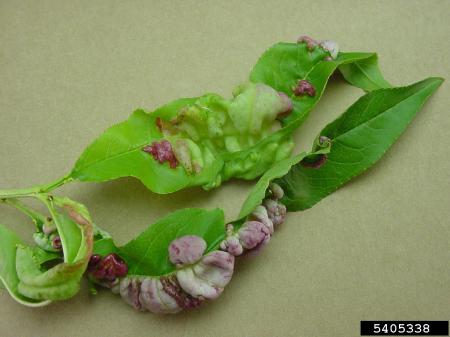
Paul Bachi, University of Kentucky Research and Education Center, Bugwood.org
Color of infected leaves can range from green-yellow to red. Leaves have thickened, distorted patches.
Species: Infected Peach
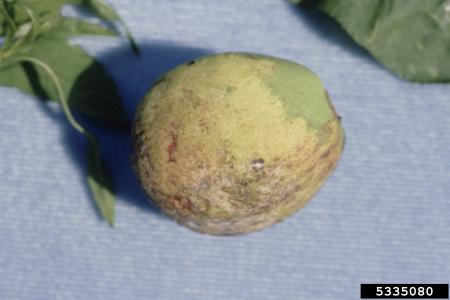
Mary Ann Hansen, Virginia Polytechnic Institute and State University, Bugwood.org
Fruits are rarely infected. If they become infected, they show reddish, wrinkled to distorted areas.
Peach Leaf Curl Benefits
- Peach leaf curl is a plant disease that distorts and damages peach and nectarine leaves. It doesn’t have any benefit for people or the environment.
Peach Leaf Curl Risks
- Peach leaf curl can greatly reduce fruit production.
- Peach leaf curl distorts and damages peach and nectarine leaves.
- It can affect tree health, vigor, yield and fruit quality.
- Uncontrolled, repeated leaf loss can cause the tree to decline. It reduces the tree's ability to produce energy.
- The tree can even die in as few as 2-3 years.
Risk Card
Does it cause harm?
Adults & Children
None
Property
Some
Pets
None
Annoyance
High
Environment
None
Action Optional
Take Action?
Peach leaf curl can greatly reduce fruit production. It can limit the ability to grow peaches in Western Oregon and Washington.
Do I need to take action?
Peach leaf curl weakens the tree and reduces fruit production. You should take action against it.
What if I do nothing?
- When conditions for disease development are good, taking no action is not a good choice.
- Severe leaf drop reduces fruit production and vigor of trees. The weakened trees are more susceptible to winter injury.
- Severe infections of leaf curl may kill trees after several years.
Prevent Peach Leaf Curl
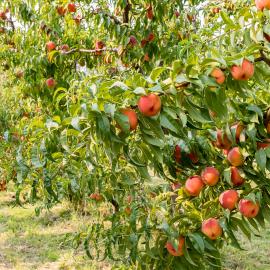
"Peach orchard in Grant County" by Washington State Department of Agriculture is licensed under CC BY-NC 2.0.
Plant Peach Leaf Curl-Resistant Varieties
- Plant disease-tolerant or resistant varieties. Monitor them regularly for signs of peach leaf curl.
- These resistant peach or nectarine cultivars are offered by a variety of west coast nurseries. Autumn Rose, August Etter, Avalon, Avalon Pride, Charlotte, Early Charlotte, Early Crawford, Frost, Indian Free, Kreibich, Muir, Nanaimo, Oregon Curl Free, and Q-1-8.
- For the highest chance of success, treat with fungicide every year. Treat them consistently with organic or conventional materials.
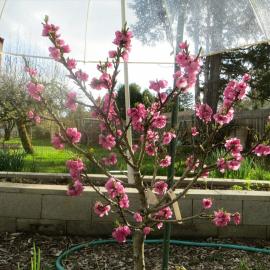
Signe Danler, Oregon State University
Good Air Movement and Dry Leaves
- Plant peaches in a sunny spot with good air movement.
- Producers in areas with high leaf curl pressure may grow peaches under a high tunnel. This prevents rain from spreading the disease in the spring. This reduces the risk of peach leaf curl.
- Careful monitoring and spraying may still be required.
- Small and household-scale growers may protect dwarf or espaliered peach trees from spring rains with a plastic cover or umbrella. They can also use a greenhouse or tunnel.
Solutions for Peach Leaf Curl
Prevention
- Planting resistant cultivars, and fungicides are the primary management tools.
- Use high tunnels or greenhouses to shelter trees from winter rains.
- Plant resistant peach varieties.
Non-chemical Methods
- Sanitation and cultural controls are not effective for this disease.
- Remove affected leaves as early as possible.
Chemical Methods
- Spray with fungicide at least the first year or two after planting.
- The most effective practice is to apply fungicide every year. Continue to apply yearly for the life of the planting, even with resistant cultivars. See Pesticide Application Tips, below, for application timing.
- Fungicides effectively control peach leaf curl when used according to the label directions.
NEED HELP?
Consider a licensed pest control company. Learn How to Hire a Pest Control Company.
Your local Extension Specialist in Oregon and other states can suggest other methods.
Jump to
| Method | Does it work? | Is it safe? | Recommendation |
|---|---|---|---|
A Plant resistant peach varieties |
Effective |
Low risk |
Recommended |
B Manage with Fungicides |
Effective |
Moderate risk |
Use if Necessary |
|
C If Using Fungicides, Protect Yourself & Minimize Risks
|
A
Plant resistant peach varieties
Non-Chemical Method
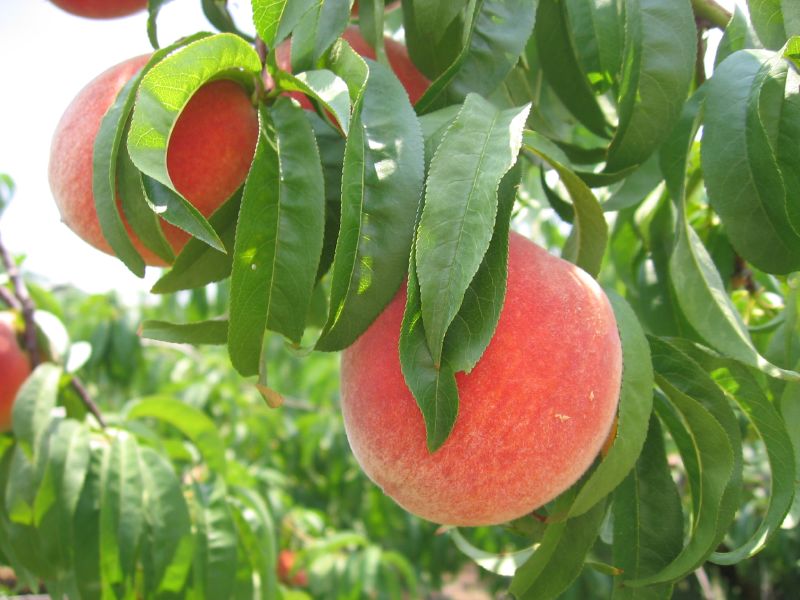
"Georgia Peach" by abbydonkrafts is licensed under CC BY-ND 2.0.
Plant resistant peach varieties
Recommended
The best way to avoid peach leaf curl is to grow varieties that are resistant to it.
| Does it work? | Effective Planting resistant varieties is effective. They will still need protection during at least the first few years. Best practice is to continue to apply fungicide yearly for the life of the planting. For a list of peach leaf curl resistant varieties, see the Prevention section. |
| How much effort? | Moderate effort |
| What's the risk? | Low risk |
| Possible risk of exposure or harm from chemicals | NONE |
B
Manage with Fungicides
Chemical Method: Use with caution

iStock
Manage with Fungicides
Use if Necessary
| Does it work? | Effective Fungicides effectively prevent peach leaf curl when used according to label directions.
|
| How much effort? | Moderate effort Fungicides must be applied before plants develop disease symptoms to work. |
| What's the risk? | Moderate risk Using fungicides comes with real risks. ALWAYS read the entire label front to back. Review instructions even for brands you know. |
| Possible risk of exposure or harm from chemicals | Using fungicides includes some amount of risk. The lowest risk comes with using alternative methods. You may be exposed to a fungicide if you:
Follow directions closely to reduce risk. |
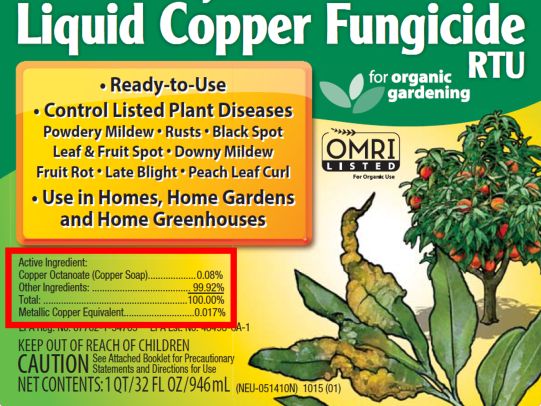
Some fungicides are available for home use. A few are listed below. These active ingredients are available alone or in products containing more than one. They are effective chemical treatments for peach leaf curl. Look for these chemical names in the “Active Ingredients” section of product labels.
- Copper octanoate
- Copper ammonia complex
- Chlorothalonil
- Copper sulfate (Bordeaux Mixture)
Suggested pesticides are from the Pesticide Information Center Online (PICOL) Database. They are permitted for HOME use in Oregon. Read the label for application directions and effectiveness information.
ONLY professional pesticide applicators can use Restricted-Use Pesticides (RUP) that may be more effective. If you need further support, contact a licensed pesticide applicator.
Fungicide Application Tips
- Proper timing of fungicide sprays is important for them to be effective against peach leaf curl.
- Fungicide products work best when applied before plant diseases get started.
- In western Oregon, two fungicide applications are recommended each year. First at 50% leaf fall (late October). Second in late February before floral buds open.
- East of the Cascades, in southern Oregon, and in low rainfall areas, one application in February should be effective. Two is still the recommended best practice.
- Check for precise application timing on the label.
- Alternate between chemical groups with different modes of action. Peach leaf curl fungus may develop resistance if only one type of fungicide is used repeatedly.
- Organic options include Copper based fungicide such as Bordeaux mix. These are also effective.
- Using fungicides comes with real risks. ALWAYS read the entire label front to back. Review instructions even for brands you know.
- Consult a commercial pesticide applicator for treatment of trees over 10 ft. tall.
If Using Fungicides, Protect Yourself & Minimize Risks
Chemical Method: Use with Caution
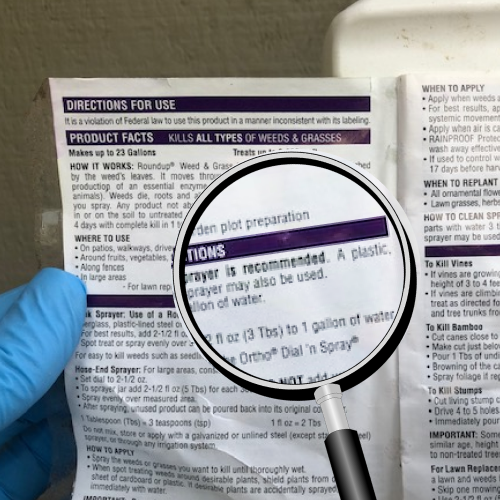
Weston Miller, Oregon State University
Why Is It Important to Read Fungicide Product Labels?
- They have detailed information on how to use the product correctly and legally.
- They contain information on potential hazards of the product.
- They provide instructions you should follow for poisonings and spills.
- Following label instructions helps you to minimize the risks and maximize the benefits.
Key Fungicide Safety Tips
- Read the entire label front to back.
- Follow the instructions.
- Review the instructions even for brands you know.
- Only apply the product where the label says it can be applied.
- Keep all fungicides in their original container.
The Label is the Law
ALWAYS read the label before using fungicide products. The label is a legal document that provides information on how to safely use the fungicide. It includes required personal protective gear and application methods. This helps avoid harm to human health and the environment. Using a fungicide in ways not listed on the label is illegal. It can result in legal enforcement actions.
READ THE LABEL & Follow Instructions
It has instructions to protect you and the environment.
- Labels are different for every product and they often change over time.
- Use a magnifying glass for small print.
- Pay attention to CAUTION, WARNING, and DANGER statements.
- Pay attention to the PRECAUTIONARY STATEMENTS.
- The law states you must read and follow fungicide instructions.
Protect Yourself
Eye, skin & lung irritants
- Wear the right protective gear. This often includes, but is not limited to: a long-sleeved shirt, pants, socks, closed shoes, safety glasses, and chemical-resistant gloves.
- Mix fungicide products outdoors or in a well-ventilated area.
- Wash hands after you mix or apply fungicides and before smoking or eating.
- Wash clothes worn while mixing and applying fungicides separately from all other laundry.
Protect Children & Pets
Children and pets are at risk if they eat or touch the plant before fungicides dry.
- Keep them away during and after applying fungicides (read label for how long).
- Remove toys and pet dishes from the yard before applying.
- Don’t track fungicide products into home on shoes or clothes.
Protect Pollinators
- Apply early morning or evening when bees are less active.
- Avoid spraying flowering plants, if possible.
- Don’t spray on bees or insects.
Storage & Disposal
- Store out of the reach of children and pets.
- Store in a cool and dry place.
- Never pour down any drain.
- If you mix too much, apply it according to the label rather than storing it.
- Don’t put fungicide containers in the trash unless instructed by the label.
- Take unused fungicides to a hazardous waste facility.
Call 1-800-CLEANUP (1-800-253-2687) to find out where to dispose of pesticides.
For the Portland metro region in Oregon, contact Metro’s Recycling Information. Call 503-234-3000, email or visit Metro’s website
More about:
About Using Pesticides on School Grounds in Oregon
If using pesticides on school grounds, there are special rules in Oregon. See School Integrated Pest Management (Oregon Department of Agriculture).
NEED HELP?
The National Pesticide Information Center (NPIC) can answer questions about pest control chemicals.
1-800-858-7378 or npic@ace.orst.edu
Consider using a licensed pest or weed control company. Learn How to Hire a Pest Control Company.
Your local Extension Specialist in Oregon and other states can suggest other methods.
Content developed by Signe Danler and Weston Miller, and reviewed by Thomas A. Jima. Pesticide safety information edited by Kaci Buhl.
Peer review facilitated by OSU Department of Horticulture.



PEACH LEAF CURL REFERENCES
Peach Leaf Curl
PNW Pest Management Handbooks
2020 Pest Management Guide for Peaches
Oregon State Extension
Managing Diseases and Insects in Home Orchards
Oregon State Extension
Peach: Leaf Curl
Washington State University Hortsense
Peach Leaf Curl: Biology and Control
Rutgers Cooperative Extension
Peach Leaf Curl
University of California IPM Program
How Growing Stone Fruit in High Tunnels Can Pay Off
GrowingProduce.com